News & Updates

Discoveries, milestones, and announcements from the Computational Molecular Engineering Lab

New paper published on Small Science by Wiley Online LibraryLatest

August 22, 2026

New paper published on Small Science by Wiley Online Library

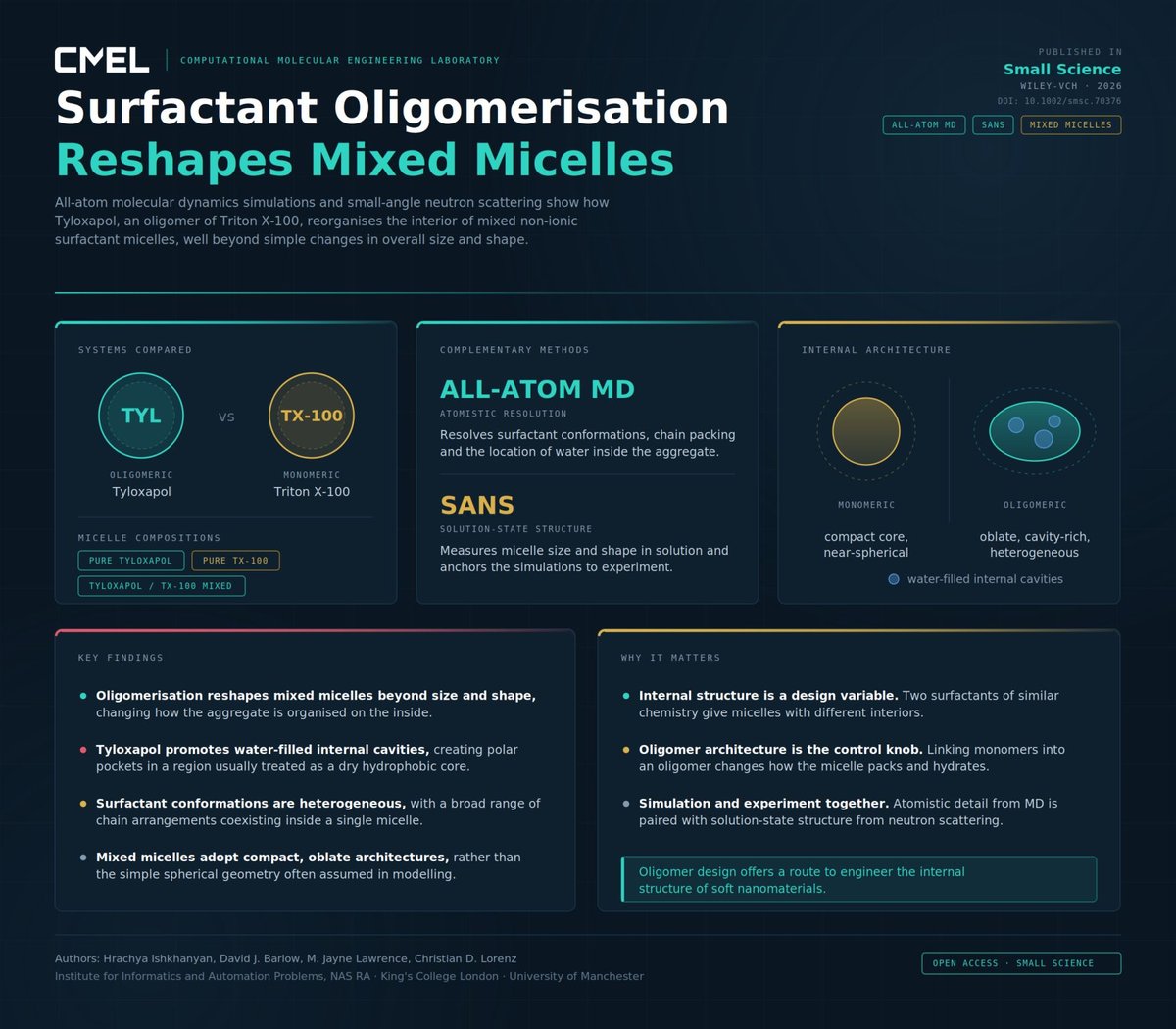
This study combines all-atom molecular dynamics simulations with small-angle neutron scattering to examine how surfactant oligomerisation reshapes non-ionic micelles. The work compares micelles formed by Triton X-100, a monomeric surfactant, with those formed by Tyloxapol, its oligomer, along with mixtures of the two. The central question is not how large or how spherical these aggregates are, but how they are organised internally, a property that conventional size-and-shape characterisation leaves largely unresolved. The simulations and scattering data together show that oligomerisation reshapes mixed micelles well beyond changes in size and shape. Tyloxapol promotes water-filled internal cavities, creating polar pockets within a region normally treated as a dry hydrophobic core, and surfactant conformations become heterogeneous, with a broad range of chain arrangements coexisting inside a single micelle. The resulting mixed micelles adopt compact, oblate architectures rather than the simple spherical geometry often assumed in modelling. Together, these findings demonstrate that oligomer design offers a route to engineer the internal structure of soft nanomaterials, not just their outer dimensions. The paper was published in Small Science in 2026 by Ishkhanyan, Barlow, Lawrence, and Lorenz.

Read more

June 10, 2026

Drug-Dependent Modulation of Micelle Morphology and Encapsulation in Triton X-100 Systems

This study uses all-atom molecular dynamics simulations to examine how Triton X-100 micelles, a nonionic surfactant system, interact with three small-molecule drugs chosen for their contrasting physicochemical properties: aspirin, atenolol, and felodipine. The simulations revealed that drug-micelle interactions are predominantly governed by the hydrophilic head groups of Triton X-100, with limited penetration into the hydrophobic core, and that aromatic and polar functional groups drive both drug–drug and drug–surfactant interactions. The three drugs behaved quite differently inside the micelle. Atenolol showed the highest encapsulation within the micelle core, while felodipine achieved the greatest overall encapsulation, in line with each drug's hydrophobicity as measured by its log P value. Drug loading also reshaped the micelles themselves, with atenolol-loaded systems showing the most pronounced deviation from a spherical form. Together, these findings advance the molecular-level understanding of nonionic surfactant micelles as drug carriers and offer a comparative framework for the rational design of tailored drug delivery systems. The paper was accepted in June 2026 in Physical Chemistry Chemical Physics by Mitchell, Ishkhanyan, Ulmschneider, and Lorenz.

Read more

January 17, 2026

Levofloxacin-loaded surfactant nanocarriers: a computational study

This study uses extensive all-atom molecular dynamics simulations to explore how levofloxacin, a fluoroquinolone antibiotic, interacts with two types of surfactant micelles: anionic (SDS) and cationic (CTAB), with the goal of evaluating their potential as drug nanocarriers. The simulations quantified both loading capacity and encapsulation efficiency, revealing a dramatic difference between the two systems: SDS micelles achieved an average encapsulation efficiency of around 80%, while CTAB micelles reached only about 8%, indicating far stronger binding of levofloxacin to the anionic carrier. The work also shed light on how levofloxacin positions itself within each micelle type. Tilted orientations were observed in both cases, roughly 48–51° in SDS and 40–42° in CTAB, with the drug's positively charged piperazine group anchoring to anionic headgroups and its negatively charged carboxylic group orienting toward cationic headgroups. Additionally, π–π interactions and hydrogen bonding were found to drive the formation of columnar stacks of levofloxacin molecules within both micelle types. The paper was published in Nanoscale Advances in 2026 by Sharoyan, Hakobyan, Melkonyan, Ishkhanyan, Poghosyan, Parsadanyan, Antonyan, and Vardevanyan.

Read more

October 10, 2025

CMEL office open in Yerevan

We are excited to announce that the Computational Molecular Engineering Lab (CMEL) has officially opened its office in Yerevan, Armenia. Located at the Institute for Informatics and Automation Problems of the National Academy of Sciences of the Republic of Armenia, 1 Paruyr Sevak Street, the office marks a significant milestone for the lab — bringing together a dedicated local team to advance cutting-edge research in molecular dynamics, nanoparticle simulations, and computational drug delivery. This new base in Yerevan strengthens CMEL's growing presence and its commitment to fostering world-class computational science in Armenia.

Read more

July 8, 2025

Self-assembly and micellar transition in a CTAB-sodium oleate mixed system: experimental and molecular dynamics validations

This study investigates the nanoscale self-assembly behavior of a mixed surfactant system composed of two oppositely charged molecules — cetyltrimethylammonium bromide (CTAB) and sodium oleate (NaOl) — in aqueous solution. Using a combination of tensiometry, dynamic light scattering, and small-angle neutron scattering, the researchers mapped out how the mixture's properties change with composition. Thermodynamic analysis revealed non-ideal mixing behavior, with the most favorable micelle formation occurring at a CTAB mole fraction of 0.25, driven by enhanced hydrophobic interactions between the two surfactants. At a fixed total surfactant concentration, the CTAB/NaOl mixtures displayed a rich variety of solution behaviors — from low-viscosity fluids to viscoelastic fluids and gel-like phases — along with striking morphology transitions including ellipsoidal micelles, cylindrical micelles, and vesicular structures. These experimental findings were further validated by molecular dynamics simulations, which provided atomistic-level confirmation of the self-assembled architectures and yielded additional molecular insights into the structural organization of the mixed micelles. The paper was published in New Journal of Chemistry in 2025 by Girase, Poghosyan, Ishkhanyan, Kumar, Aswal, and Kuperkar.

Read more

April 4, 2025

Potential functional changes in native lysozyme induced by carbon nanotubes studied by molecular dynamics simulations

This study uses long-scale molecular dynamics simulations (1–2 microseconds) to investigate how carbon nanotubes (CNTs) interact with lysozyme — an antimicrobial protein — and whether that interaction alters the protein's structure and function. Four scenarios were compared: native and denatured lysozyme, each with and without a docking step to optimize the initial protein-CNT configuration. The CNT surface adsorbs lysozyme primarily through π–π stacking and van der Waals interactions, with arginine and tryptophan residues identified as the key amino acids driving the binding. The results reveal a striking dependence on both protein state and simulation setup. Native lysozyme does not undergo significant conformational changes when simply placed near a CNT, but after docking, the complex exhibits notable structural reorganization. Denatured lysozyme, by contrast, binds more effectively in both scenarios, coating the nanotube surface with roughly three times as many residues as the native form. These findings highlight the importance of the docking step in protein–nanoparticle simulations, as its inclusion or omission can lead to entirely different conclusions about a nanoparticle's toxicity or functional impact. The paper was published in Scientific Reports in April 2025 by Vaez Allaei, Amininasab, Ishkhanyan, and Poghosyan.

Read more

February 10, 2025

Publication in Journal of Chemical Information and Modeling

PUCHIK (Python Utility for Characterizing Heterogeneous Interfaces and Kinetics) is a new open-source Python package for analyzing molecular dynamics simulations of nanoparticles. Accurately describing a nanoparticle's interface is crucial for understanding its internal structure, interfacial properties, and ultimately, its functionality. While current computational methods provide reasonable descriptions for spherical and quasi-spherical nanoparticles, there remains a need for effective models for aspherical structures such as capsules and rod-like systems. PUCHIK addresses this gap with an algorithm that works for both spherelike and aspherical particles. With an accurate description of the location of the interface of the nanoparticle, this algorithm then allows for various other important quantities (e.g., densities of different atom/molecule types relative to the interface, volume of the nanoparticle, amount of solubilized molecules within the nanoparticle) to be calculated. In developing the software, the authors focused on providing good performance for computationally demanding projects, while ensuring that the methodological approach can be adapted as a protocol for other code implementations. Developed by Hrachya Ishkhanyan, Alejandro Santana-Bonilla, and Christian D. Lorenz, it was published in the Journal of Chemical Information and Modeling in February 2025.

Read more

October 1, 2024

CMEL gets the initial funding

In 2024, funding for the Computational Molecular Engineering Lab was approved by Armenia's Higher Education Science Committee. The funding was obtained through the "Adjunct Research Professorship Program 2024 (ARPI Remote Laboratory)" grant, awarded to the PI, Prof. Chris Lorenz, and co-PI, Dr. Hrachya Ishkhanyan.

Read more